High Ceilings, Stairwells, and Two-Story Walls: How Painters Actually Reach Them
Come October, painting in Whatcom County moves indoors, and every fall we get a version of the same call. The house got painted room by room over a few summers of weekends. The bedrooms look great. And then there’s the stairwell, or the two-story living room wall, still wearing the builder’s flat white, because standing on a ladder over a staircase is where the weekend plan quietly died.
No shame in that. It’s the correct instinct.
Height Changes the Job More Than People Expect
Painting an 8-foot bedroom wall and painting a 16-foot great room wall are almost different trades. Not because the paint goes on differently. Because of everything around the paint.
A roller on an extension pole reaches the middle of a tall wall just fine. What it can’t do is cut a clean line where the wall meets the ceiling. That line is the difference between a room that looks professionally painted and one that looks close but not quite, and at 16 feet it has to be brushed by hand, by someone standing on something stable, with a steady arm that stays steady for the whole length of the wall.
Drips behave differently up high too. A run you’d catch instantly at eye level has time to sag and skin over before you ever see it from the floor. And rolling overhead for an hour is genuinely tiring in a way that shows up in the finish, because a tired arm presses unevenly and leaves lap marks.
The Stairwell Problem, Specifically
A stairwell wall combines the worst of everything: full two-story height, no flat floor to stand on, and a handrail exactly where you want your ladder. This is the wall people start and abandon.
The fix is equipment, not bravery. On a typical Whatcom stairwell we’re working with ladder levelers that let one leg sit on a lower tread, articulating ladders that fold to match the stairs, and plank staging spanning between supports so there’s an actual platform to work from. Big two-story foyers sometimes get interior scaffolding. None of this is exotic to a crew that does it weekly. All of it is awkward and a little dangerous the first Saturday a homeowner tries it.
That’s the calculation worth doing honestly: the gap between a pro bid and a DIY weekend narrows fast once you price ladder rentals and your own time, and it disappears entirely the moment anyone slips on a stair tread ten feet up.
What It Looks Like Done Right
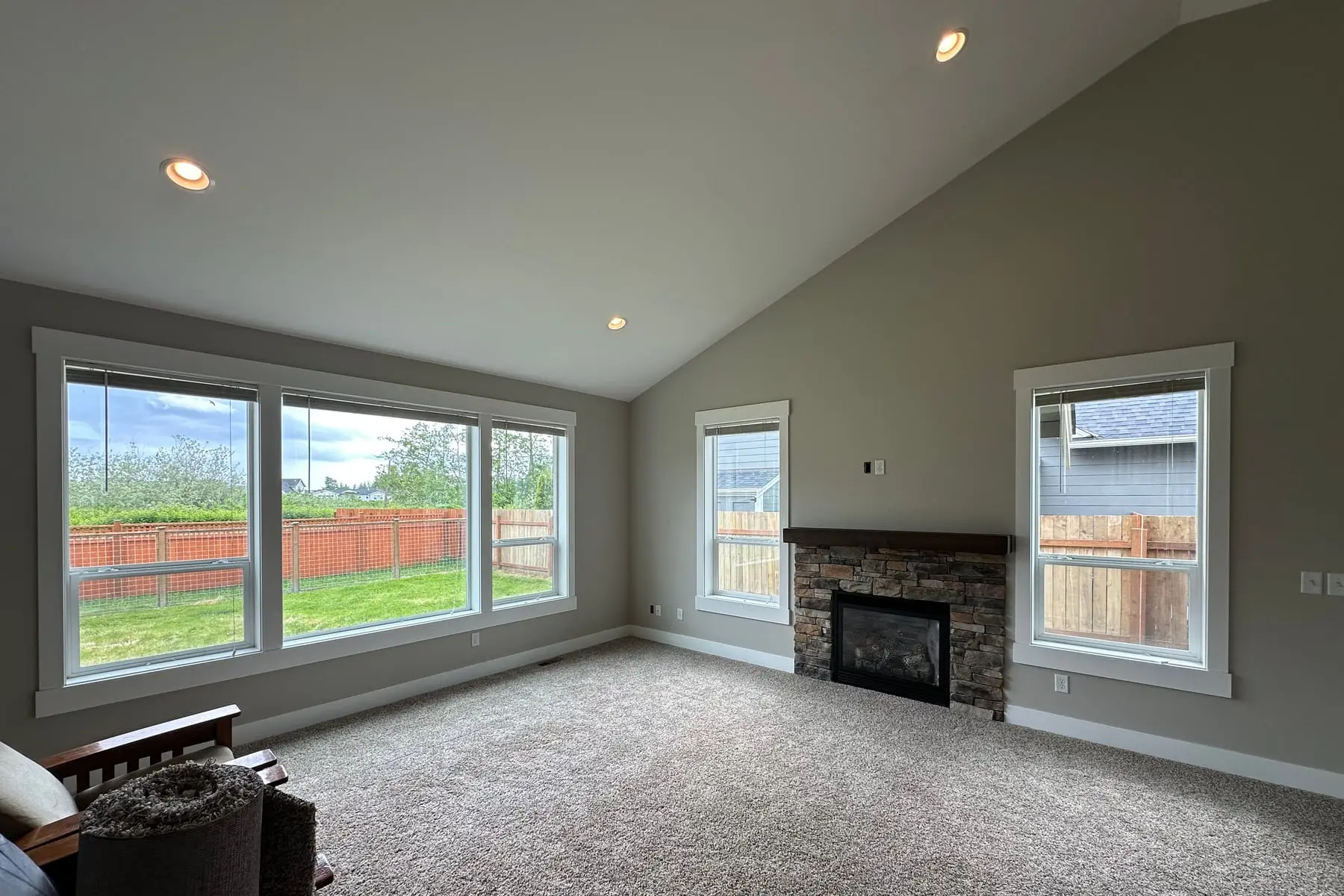
Last year we repainted a newer Ferndale home built around a vaulted great room, peaks, stairwell and all, in Worldly Gray SW 7043. The tall work there was the same as it always is: mask everything below, cut the peak lines by hand, roll the fields in two full coats, and leave no evidence anyone was ever up there except the color. That’s the whole standard, at any height: from the floor, it should just look easy.
Where DIY Genuinely Makes Sense
Standard-height rooms are honest DIY territory. If your feet stay on the floor or the second step of a ladder, and the ceiling line is within a comfortable arm’s reach, a careful homeowner with decent tools can get a result worth being proud of. Our room-by-room sheen guide covers the choices that matter more than technique does at that height.
Save the hiring for where the height is. Plenty of our interior jobs are exactly that shape: the homeowner has done the bedrooms, and we do the stairwell, the landing, and the great room so the whole house finally matches.
Fall Is the Time to Book It
Interior season here runs October through early spring, and it fills the same way the summer exterior calendar does. If a tall wall has been bugging you for years, this is the window: an interior estimate now gets the awkward wall done before the holidays, when the room is full of people looking at it.
We bring the ladders. You keep your Saturdays. Details on everything we handle indoors are on our interior painting in Bellingham page.
Common Questions